When Reality Hurts: Men’s Loneliness Around the World and Love Dolls
On this page
Human connection / A researched essay
Loneliness is a global issue. For some men, dating pressure and limited emotional support make private comfort especially appealing. A closer look at the international evidence-and the place adult love dolls can have in that story.
Dolls Review editorialResearch checked 4 October 202615 min read
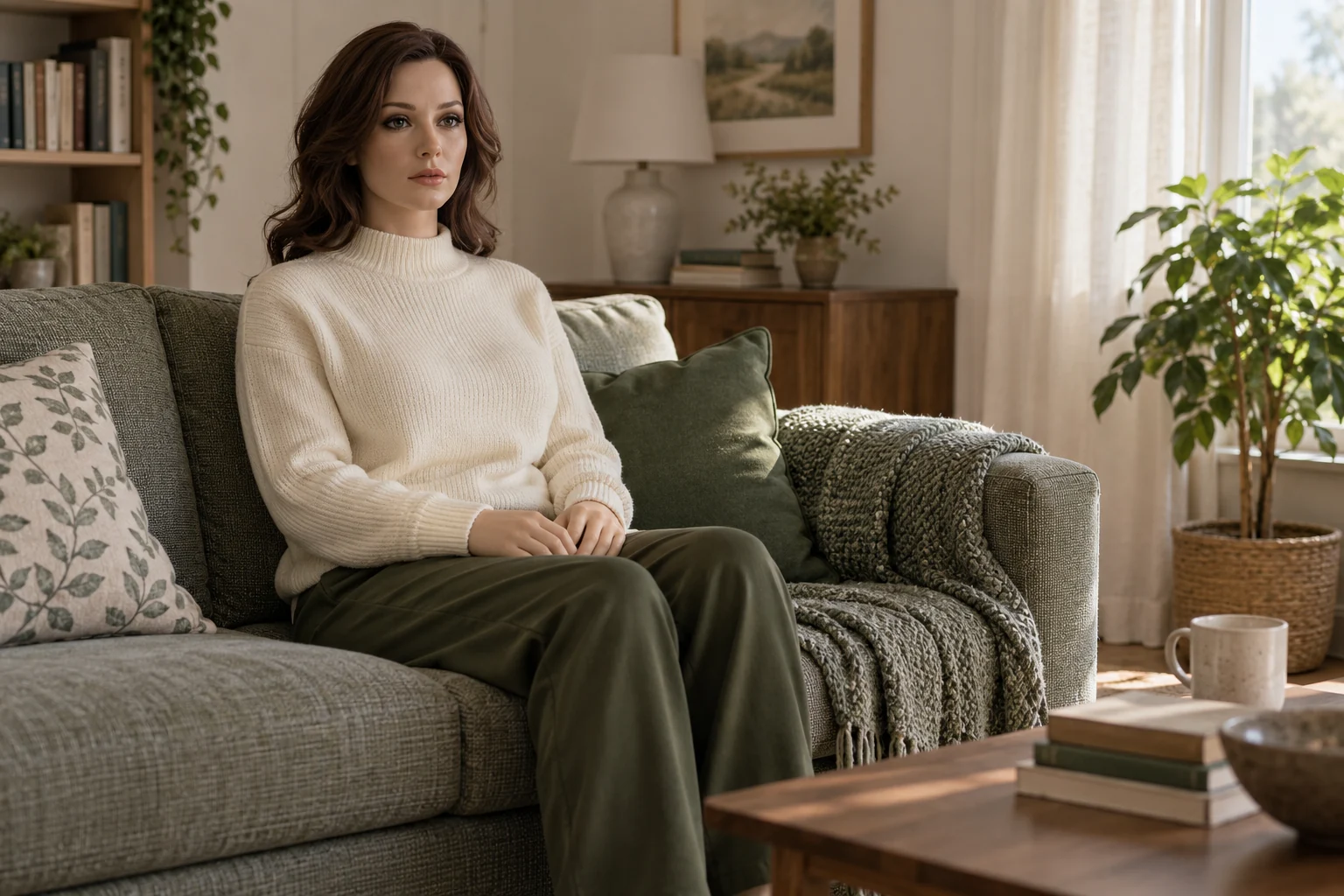
Some evenings, the hardest part is returning to an empty room. AI-generated conceptual image; not a research participant.
There is a kind of exhaustion that rarely appears in a dating profile. You go to work, pay your bills, try to look after yourself, and still come home wondering whether anyone will ever choose you. Another unanswered message can feel less like a missed introduction and more like a verdict on your whole life.
For a man in that position, finding a kind, compatible woman can seem painfully difficult. The pressure to earn more, look better, be more confident and somehow make rejection feel effortless can turn the search for love into another job. Wanting a break from that pressure is understandable.
Some people find that break in an adult sex doll or love doll: a private sexual outlet, a familiar presence, or an object around which they build a comforting routine. That choice deserves a serious conversation. It deserves compassion-and evidence accurate enough to withstand scrutiny.
01 / The global picture
A worldwide problem, experienced in different ways
1 in 6Estimated global loneliness prevalenceWHO, 2025 report; evidence from 2014–2023.
13%EU respondents lonely most or all of the timeEU Loneliness Survey, 2022; previous four weeks.
The World Health Organization’s 2025 report estimated that 15.8% of people globally experienced loneliness. Its public guidance says rates are similar for males and females. This is a broad human problem, even when this article focuses on men’s experiences. WHO also identifies low income, illness, relationship breakdowns and weak community resources among the factors involved. WHO: social connection.
The European Commission’s 2022 survey found that 35% of respondents felt lonely at least some of the time, including the 13% who felt that way most or all of the time. The EU27 sample included 25,646 people aged 16 and over, recruited through online consumer panels rather than a random population sample. These figures describe respondents’ answers, with the usual survey limitations. JRC: loneliness prevalence.
A second major international source, the Meta–Gallup study, surveyed people in 142 countries and areas from June 2022 to February 2023. Globally, 24% of men and 24% of women reported being very or fairly lonely. National estimates came from approximately 1,000 respondents aged 15 and over per country, with population weighting. The different question explains why its result should not be treated as interchangeable with WHO’s estimate. Meta–Gallup: global social connections.
National surveys add context beyond Europe and North America. Japan’s December 2024 Cabinet Office survey recorded 4.3% feeling lonely often or always, 15.4% sometimes and 19.6% occasionally; it received 10,876 valid responses from a randomly selected sample of 20,000 people aged 16 and over. In Great Britain, an ONS survey from 8 January to 2 February 2025 found 23% of men and 27% of women lonely often, always or some of the time. These measures and thresholds differ. Japan: national survey summary; ONS: Great Britain.
A relationship-status statistic cannot tell us how many people feel lonely. Someone can enjoy being single; someone else can feel profoundly alone in a marriage. Likewise, averaging these different survey percentages would manufacture a misleading global number.
02 / A closer look at men
What makes loneliness especially hard for some men
A 2019 meta-analysis combined 751 effect sizes covering 399,798 people. Its overall gender difference was very small (g = 0.07), with similar average loneliness levels across males and females. That does not erase men’s suffering. It directs us toward the particular men, circumstances and kinds of disconnection that need attention. Maes and colleagues: gender and loneliness.
The OECD’s 2025 report provides a reason for concern: in its comparisons between 2018 and 2022, men experienced larger deteriorations in loneliness and relationship satisfaction than women, even though men had traditionally reported better outcomes. It highlights younger men as driving many deteriorations among young people. This describes change in the populations and years covered by the report, not a finding that men everywhere are now lonelier than women. OECD: social connections and loneliness.
Two concrete vulnerabilities
18% vs 12%
Social isolation in Australia
Male and female rates, respectively, in 2024 HILDA data for people aged 15+. AIHW’s isolation measure uses a four-item index about support and relationships. Its separate loneliness measure was 15% for males and 16% for females. AIHW analysis.
38% vs 54%
Turning to a friend in the US
Men and women, respectively, who said they would be very or extremely likely to seek a friend’s emotional support. This is willingness to reach out, not the percentage who have a friend. Pew, 2024 survey.
In that Pew survey of 6,204 US adults, men and women reported similar loneliness and were about equally likely to have a close friend. But men were less likely to turn to a mental health professional for emotional support: 16%, compared with 22% of women. A network can exist without being a network someone feels able to use.
Young men: a closer international comparison
Gallup’s pooled 2023–2024 data found 25% of US males aged 15–34 felt lonely a lot of the previous day, compared with 18% of US females the same age. This is a stronger male-specific finding, but it belongs to that age group and country. Gallup: younger men across OECD countries.
Selected country results: males aged 15–34, lonely a lot of the previous day
Country / comparison
Reported rate
Türkiye
29%
United States
25%
France
24%
Ireland
23%
Canada
22%
Median across 38 OECD countries
15%
Selected examples reported by Gallup, not a complete country ranking. The OECD figure is a median of country rates, not a population-weighted global rate. Age 15–34 includes adolescents; this article’s discussion of doll ownership concerns adults.
Gallup also found that younger men’s rates were similar to the national average in most OECD countries. We should therefore take the US pattern seriously without projecting it onto every culture.
There is also a large cross-cultural study that found higher loneliness among men, especially younger men in more individualistic cultures: Barreto and colleagues’ BBC Loneliness Experiment analysis covered 46,054 participants in 237 countries, islands and territories. However, it was a voluntary online sample heavily concentrated in the UK. Wide geographic reach does not make it a representative survey of the world. Barreto and colleagues: age, gender and culture.
For men, the practical concern is not only how often they report loneliness. It is also whether they have someone they can trust when a relationship ends, work becomes difficult or rejection starts to feel personal. Our interpretation is that private comfort may become especially appealing when that support feels out of reach. These population studies did not measure whether such men subsequently bought dolls.
03 / The search for a partner
When “good enough” never feels good enough
A much-shared Pew Research Center finding offers a useful-but specific-snapshot. In a July 2022 US survey, 63% of men aged 18–29 described themselves as single, compared with 34% of women that age. “Single” meant neither married, living with a partner, nor in a committed romantic relationship. The full survey included 6,034 adults; that is not the size of the young-men subgroup. Pew: single Americans.
That gap does not establish its cause. It does not show that all those men were unwanted, lonely or sexually inactive, or that women were collectively choosing a small elite. It also cannot be relabeled as a worldwide statistic for 2026.
Do women look for men with greater resources?
There is evidence for an average difference in stated preferences. A 2020 study with 14,399 participants across 45 countries found that women, more than men, preferred partners with good financial prospects and older partners; men, more than women, preferred youth and physical attractiveness. Walter and colleagues: mate preferences.
But preferring financial prospects does not mean every woman requires a man richer than herself, continually seeks an upgrade, or will reject an ordinary working man. The study measured preferences, not a causal explanation for rising loneliness. A person’s income is also a poor shorthand for the whole value of a partner.
The desire to “date up” is not exclusive to women. Bruch and Newman’s 2018 study of heterosexual messaging on one dating service in four US cities found that both men and women pursued people about 25% higher in the researchers’ desirability measure, on average. That ranking came from messaging patterns-not an objective score of human worth, and not a claim that partners earned 25% more. Bruch and Newman: aspirational pursuit.
Dating apps can make both sides feel unseen
US dating-app users / Surveyed in 2022
64%
of men using a dating site or app in the previous year felt insecure about too few messages, at least sometimes.
54%
of women using one in the previous year felt overwhelmed by the volume of messages, at least sometimes.
Different difficulties in the same environment. Pew: online dating findings.
Pew also found that 53% of people who had ever used online dating described their overall experience positively, while 46% described it negatively. The evidence allows room for successful connections as well as frustration. The experiences of recent users and lifetime users are different denominators.
Our reading of these findings is that some men experience dating as a relentless competition, while women may face an exhausting flood of approaches. Turning that into a story about one sex being bad loses the people behind the numbers. Wanting affection is reasonable. So is wanting safety, compatibility and the freedom to choose.
You can want a human relationship and still want relief from the search for one.
Dolls Review / Editorial perspective
04 / A quieter form of intimacy
Why an adult love doll can feel like a refuge
A doll removes some of the uncertainty involved in approaching another person. There is no unread message to interpret and no expectation of winning someone over. For some owners, the appeal includes sexual pleasure. For others, it also includes dressing a doll, taking photographs, cuddling or simply having a familiar presence at home.
A manufactured companion can carry personal meaning without being a person. AI-generated illustration; not a product photograph or owner testimonial.
In a 2023 qualitative study, researchers interviewed nine male doll owners aged 21–68. Their accounts included companionship, emotional protection after difficult relationships, and managing social or intimate anxieties. These are descriptions of how a small group understood their lives. They show that the experience can matter; they do not show how common it is or establish that buying a doll improves mental health. Lievesley and colleagues: owners’ lived experiences.
Another study, published in 2022, used five in-depth interviews and 131 written survey reports to investigate doll use. It distinguished dolls used mainly as sex toys, as substitutes for a desired human partner, and as synthetic partners. Nonsexual activities were also reported. Recruitment through doll communities and self-selected participation limit generalization. The original report count is not the denominator for every later analysis. Peschka and Raab: a mixed-methods study.
A separate comparison of 158 owners and 135 non-owners, first published online in 2022, found no substantive differences in most measured psychological traits, although owners reported lower sexual self-esteem and some different beliefs about women and the world. That finding resists a simplistic stereotype of owners, without making every attitude or pattern of use healthy. The groups were not a randomized experiment. Harper and colleagues: psychological characteristics.
Privacy can be part of the appeal, and stigma can be part of the burden. A 2025 paper developed a measure of public attitudes through studies with 377, 329 and 292 participants. Its dimensions included acceptance and perceptions of owners as immoral or dysfunctional. It studied attitudes toward ownership, not whether owners’ loneliness improved. Harper and colleagues: attitudes toward ownership.
These studies do not provide a representative worldwide count of male doll owners, or the share who bought one because of loneliness. That missing evidence matters: a global social problem should not be turned into an invented global sales story.
05 / Comfort without shame
It is okay to need an escape. Notice what it does to your life.
You do not have to turn every lonely evening into a self-improvement project. Taking time away from dating, enjoying fantasy or choosing a private sexual outlet can be a reasonable personal choice. Owning an adult doll does not diminish your worth, and you do not need to frame it as a defeat.
Research on escapism offers a useful distinction. Stenseng and colleagues’ 2012 model separates self-expansion-seeking positive experiences-from self-suppression-trying to avoid unpleasant thoughts or feelings. Their work concerned activity engagement, not doll ownership, so applying it here is an editorial lens rather than a tested result about dolls. Stenseng and colleagues: escape motives.
A useful personal check
After this private comfort, do I feel more able to take part in my life-or do I keep shrinking my life to avoid discomfort?
Can I still make time for friends, ordinary responsibilities and interests outside the doll?
Am I spending within a budget I can afford?
Can I accept that a doll offers an experience, while a human relationship involves another person’s choices and needs?
If I am struggling, can I seek help without feeling that it invalidates what comforts me?
These are reflection prompts, not a diagnostic checklist.
Someone who feels persistently distressed or increasingly unable to work, sleep or connect with others deserves support. WHO identifies psychological therapies and community connections among approaches to social disconnection. That is compatible with enjoying a doll; there is no requirement to choose only one source of comfort. WHO: promising approaches.
06 / The financial question
Is a doll cheaper after three or four uses?
It can be, under particular prices. It is not a universal rule. A doll has a substantial upfront cost and ongoing care costs. A paid encounter has a recurring price. An unpaid one-night relationship has no standardized “fee,” and neither scenario is equivalent to buying mutual affection.
For a concrete retail snapshot, Silicone Lovers displayed a WM “Lucky Lucy” listing at US$1,395, a Zelex SLE “Sabra” listing at US$1,600, and an Irontech “Celine” listing at US$2,250 when checked on 4 October 2026. These are advertised prices from one retailer, not a market average or a guarantee of the final checkout total in every country. Silicone Lovers: displayed USD prices.
Illustrative scenarios / US dollars
The first use at which the doll costs less
Assume $5 of additional consumables per use. All figures below are hypothetical budgeting inputs, including the encounter prices-not observed international averages.
Swipe the table to compare all three encounter prices →
First whole-number use with a lower cumulative cash cost
All upfront doll costs
$250 per encounter
$400 per encounter
$500 per encounter
$1,200
5th use
4th use
3rd use
$1,600
7th use
5th use
4th use
$3,200
14th use
9th use
7th use
Doll cost after n usesA + (m × n)Encounter cost after n encountersP × n
A = purchase, delivery, taxes and initial setup; m = recurring doll cost per use; P = total cost per encounter. The doll costs less when n > A ÷ (P − m), assuming P > m. We use the first integer strictly above that threshold; equality is a tie.
For example, with $1,600 upfront and $5 per use, four doll uses cost $1,620. Four encounters at $500 cost $2,000. The doll is cheaper in that scenario. At $250 per encounter, however, four encounters cost $1,000; the same doll does not become cheaper until the seventh use.
A complete budget should allow for cleaning and drying supplies, compatible lubricant, storage, clothing if wanted, repair and eventual replacement. Add import charges or financing costs where they apply. Time spent on care matters too, even though this table does not assign it a dollar value. If a doll is damaged early, rarely used or replaced quickly, the expected saving may disappear.
This is a comparison of spending, not a judgment about sex workers or the worth of relationships. It assumes consensual adult services in a place where they are legal. The useful conclusion is modest: repeated use can lower the cost of one form of private sexual pleasure; it does not put a price on love.
07 / Keeping the door open
Comfort can be part of a life that still grows
If you are worn down by dating, it can be kinder to yourself to pause than to keep collecting experiences that make you feel smaller. You can want a loving woman in your life and still admit that you are tired. You can also decide that a relationship is not what you want right now.
For some adults, a doll belongs in that pause. For others, it is a lasting hobby or sexual preference. The research presented here gives us reasons to listen to those experiences, while leaving the long-term effects uncertain.
What matters is whether the choice fits the life you want. Make room for comfort, but also for friendship, shared interests, movement, work you care about and people who can respond to you. A doll can be meaningful to its owner. It cannot offer another person’s freely chosen love.
And when you return to dating-if you choose to-look beyond the language of rankings. Finding a good partner asks for attraction, kindness, reliability and compatible hopes. It also asks us to recognize those qualities in ourselves and in the person across the table.
You deserve comfort without shame. You also deserve a life with room for connection.
Editorial position: choosing private adult comfort need not be shameful. That is a value judgment, separate from the empirical claims above. Both images were generated with AI for this article and depict fictional scenes.